Showing posts with label Essay Plan. Show all posts

Tuesday, 15 March 2016

Audiences and Institutions (Technology) Essay and Plan

Essay - 

Hardware: Equipment
Content: Films
Media: Institutes diverging information to a mass audience
Area: Film

Examples: 
  • CGI
  • IMAX
  • Convergence of equipment (E.G. smartphones used by indie companies and more convenient streaming for audiences at home or on the move)
  • Streaming services
  • 3D/ 4D
Effects:
  • Piracy
  • Decrease cinema viewing
  • Hollywood near collapse 2000 (Netflix streaming) 
Overcoming Piracy:
  • Same international release day
  • Phasing out use of CD's, DVD's and BLU-ray which can be copied
  • Infrared screen distortion on cinema screens to stop illegal recording


Tuesday, 8 March 2016

Media Exam Question Global Institutions -

Media Exam Question - 
  • Media production is dominated by global institutions, which sell their services and products, to national audiences. To what extent do you agree with this statement?


Media production is dominated by global institutions which sell their services and products to national audiences. To what extent do you agree with this statement?

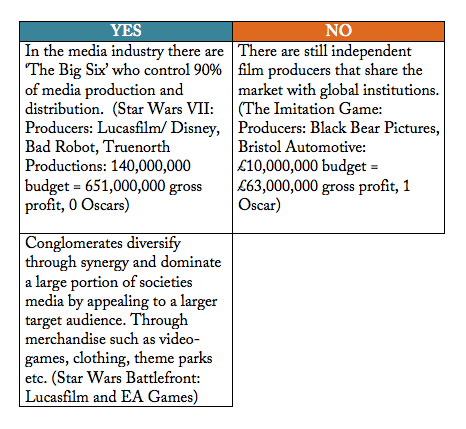
Firstly, within media production there have been many changes as the industry develops in a modern world. For example, in 1983 90% of the American media industry was distributed between 50 companies whereas this has changed recently, in 2011, to six large conglomerates owning 90% of the production and distribution industry that are known as ‘the big six’. These six large companies consist of: Universal, Disney, Paramount, Sony, 20th Century Fox and Warner Bros Pictures. Between these six companies 90% of the industry is shared meaning that the choice for the consumer is severely limited as bourgeoisie owners of the media choose which productions to pass onto the mass audience which dramatically, even subconsciously, affects their everyday life. For instance, Disney recently purchased the Star Wars franchise from Lucas film ltd and produced Episode VII: The Force Awakens, alongside Bad Robot and Truenorth Productions, which had a £140,000,000 budget and made an estimated gross profit of £651,000,000. The expensive purchase of this particular franchise was a calculated move made by Disney as they were aware that the influence of their position as one of the big six meant that they already had an established mass audience. This audience are reliant on receiving media from these few conglomerates due to media domination and therefore would buy into the businesses productions most likely out of lack of choice, conformity and loyalty.

On the other hand, it can also be argued that there are still a variety of independent, indie, film producers which share the market with large global institutions. Whilst the big six dominate 90% of the media industry there is still 10% unaccounted for which is likely to be comprised of independent film companies. The big six are not responsible for every large blockbuster film that is sold to mass audiences despite many contradicting beliefs. For instance, The Imitation Game was produced by Black Bear Pictures and Bristol Automotive with a budget of £10,000,000 which resulted in an estimated gross profit of £63,000,000 and an Oscar win which Star Wars: The Force Awakens did not achieve. There are a variety of smaller indie film companies that produce large grossing films that reach mass audiences and together command a large segment of the media industry and therefore cannot be considered completely inferior to the big six conglomerates.

Although, there is more evidence to support the idea that global institutions dominate the media industry and the productions that are distributed to mass national audiences. Conglomerate media companies diversify through synergy thus dominating large percentages of society’s media by developing inventive ways to reach larger audiences by selling their services and products on a variety of social media platforms. For example, many of the big six media companies, in cohesion with specific media productions, and as part of their distribution services, diversify their media to a mass national audience through merchandise including video-games, clothing and even theme parks. A specific examples of this is the cross-media convergence of Lucasfilm ltd, who Disney purchased the rights to Star Wars from, working alongside EA Games to create Star Wars Battlefront. Star Wars Battlefront was a video-game targeted at a next-generation console gamer audience who shared the excitement over the new Star Wars film due to be released at a similar time; this particular cross-media convergence made over £460,000,000 in sales of 13,000,000 copies of the video-game which also helped to increase media hype over the film which was due to hit cinemas around the time of release of the game.

Therefore, there is evidence to suggest that independent film companies are still responsible for some of the material that reaches the mass national audiences but the media industry is largely controlled and dominated by the big six global institutions.

Tuesday, 2 February 2016

'A Touch Of Frost' Disability Analysis Essay Preperation -

Disability - 
https://www.youtube.com/watch?v=1C6thBrPD6g

Camera:
  • Panning shot as the police chase after 'Billy'

Editing:
  • Jump cuts which contrast between the disabled and the 'fully able' officer/ parents

Sound:
  • The crescendo music during the police chase of 'Billy'

Mise-en-scene:
  • "Mentally subnormal" (Police officer about 'Billy')
  • "Handicapped" (Parents about 'Billy')
  • Mother was going to 'clean him up' 
  • Billy: 'I was frightened' by the police
  • The officer asked the father rather than the disabled character 'Billy' 
  • 'Billy' is disabled due to his down syndrome
  • The lighting is darker on 'Billy' to make him appear more suspicious and 'dimmer' mentally
  • People are patronising towards him, speak like a child

Tuesday, 26 January 2016

Eastenders Analysis Regional Identity and Ethnicity Representations Essay -

Eastenders -  https://www.youtube.com/watch?v=heA414lv6gc

Camera:
  • Medium shot
  • Medium three shot
  • Close-up on phone


Editing:
  • Jump/ straight cuts
  • Cut in on the phone


Mise-en-scene:
  • Matriarchal family figures: Cora, Zainab, Sharon and Carol
  • Zainab states that the damage of property could be considered a hate crime against Muslims
  • Zainab refers to the young people of London as 'hoodlums'
  • Carol assumes that Zainab lives in a council house
  • Zainab is regional manager of the area
  • The application of an Asian family to own the local corner store (stereotype)

Sound:
  • East London accents
  • Pakistani accents


Other:
  • Setting: East London
  • Racial Groups: London, Pakistani
  • Stereotypes: Council houses due to low income of the region

Essay -

How are regional identity and ethnicity presented in the media text 'Eastenders'?

The media text 'Eastenders' depicts multiple theories and social groups within the episode stated above.

To begin with, the establishing shot demonstrates the setting as East London, a significant culturally diverse population, which is also represented in the cast of the TV soap. Social, racial and regional groups are all displayed within the programme. For instance, mise-en-scene is important in indicating both regional and racial identity in the episode through the use of matriarchal family structures. Possibly the most significant matriarch is Zainab Masood. The character of Zainab Masood is from Pakistani heritage in which the cultural norm is for the females to be dictated by their male counterparts such as fathers, brothers and husbands. Zainab Masood is therefore flouting the ideologies of her ethnicity, despite her role as matriarch still being domestic, whilst conforming more to the regional identity of the powerful working businesswoman in modern London.

Furthermore, sound also plays a large role in exemplifying ethnicity and regional identity through the use of accent, dialect and socialect within dialogue in the text. Accent is the sound of pronunciation influenced by ethnicity and regional identity whilst sociolect is language used by social groups and finally dialect is language used by certain regions and subcultures. For example, accent introduces the ephemeral regional identity and ethnicity that is present due to the contrasting variety of accents including those of East London and Pakistani.

Also, the mise-en-scene in the development of plot helps to exaggerate ethnicity within the media production. The ethnic stereotype that Asian families run local shops is supported by the secondary plot of the Masood's applying for ownership of the 'Minute Mart'. Thus, this develops stereotypical ideal in the representation of ethnicities and regional identity within East London.

Additionally, another example of regional identity is the feature of production, mise-en-scene. A stereotype associated with the regional area of East London is the much stigmatised idea that residents all occupy council housing. An example of this from within the episode is when the character of Carol assumes that Zainab lives in a council house to which the response is far from satisfied. As a result, the ideas that council housing is a negative stereotype within London is supported by the episode through the use of character and dialogue.

Finally, regional identity is further represented through dialogue and character in the media production 'Eastenders'. The idea that the East London region is full of young people who all misbehave and belong to delinquent youth anti-society subcultures, relating to Cohen's theory on youth subculture representation within media being over presented, is shown through Zainab referring to the character of Lauren as a 'hoodlum' resulting from the party culture held by the character. This is a regional identity based stereotype about London which is supported due to the norms and values held by the producer which is then imparted to the receiver therefore enforcing hegemony.

To conclude, regional identity and ethnicity displayed in the episode of 'Eastenders' could easily be interpreted as biased and influenced by the ideals held by the producer rather than being a more representative example of the reality within an East London region and the depiction of specific ethnicities.

Regional Dialect In Doc Martin Analysis -

Doc Martin -

Editing:
  • Jump cuts to show the stark difference between the Londoner and the Cornish/ Devonshire people
Sound:
  • The accents of characters
  • 'Bodmin' meaning crazy
  • Calling an adult 'boy' 
  • Comical slow yet upbeat music supports the idea of country 'bumpkins'
Camera:
  • Low angle camera shot shows the lower class status
  • Panning shot following them down the small town high-street in the cliff tops
Mise-en-scene:
  •  They don't use nouns
  • Cornish/ Devonshire people are uneducated
  • The Cornish man is lazy
  • The southerner is out of place
  • Small town where everyone knows everyone
  • Family businesses
  • Doc Martin suggests that the northerners don't even know how to use a mop
  • Blue jumpsuits for working class (blue collar workers) plumbers family business
  • Vegetable cart prop
How to Identify Regional Identity - 
  • Setting
  • Accent
  • Dialogue
  • Props
  • Makeup
  • Class of characters
  • Costumes