Showing posts with label Essay. Show all posts

Tuesday, 15 March 2016

Audiences and Institutions (Technology) Essay and Plan

Essay - 

Hardware: Equipment
Content: Films
Media: Institutes diverging information to a mass audience
Area: Film

Examples: 
  • CGI
  • IMAX
  • Convergence of equipment (E.G. smartphones used by indie companies and more convenient streaming for audiences at home or on the move)
  • Streaming services
  • 3D/ 4D
Effects:
  • Piracy
  • Decrease cinema viewing
  • Hollywood near collapse 2000 (Netflix streaming) 
Overcoming Piracy:
  • Same international release day
  • Phasing out use of CD's, DVD's and BLU-ray which can be copied
  • Infrared screen distortion on cinema screens to stop illegal recording


Tuesday, 8 March 2016

Media Exam Question Global Institutions -

Media Exam Question - 
  • Media production is dominated by global institutions, which sell their services and products, to national audiences. To what extent do you agree with this statement?


Media production is dominated by global institutions which sell their services and products to national audiences. To what extent do you agree with this statement?

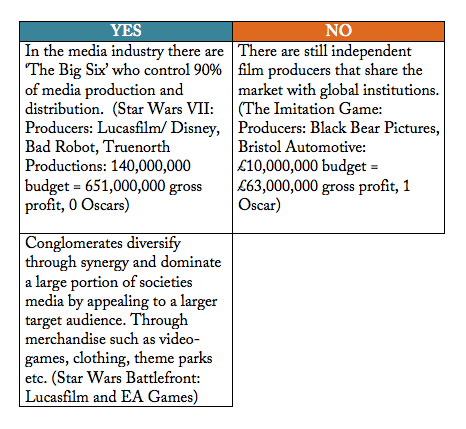
Firstly, within media production there have been many changes as the industry develops in a modern world. For example, in 1983 90% of the American media industry was distributed between 50 companies whereas this has changed recently, in 2011, to six large conglomerates owning 90% of the production and distribution industry that are known as ‘the big six’. These six large companies consist of: Universal, Disney, Paramount, Sony, 20th Century Fox and Warner Bros Pictures. Between these six companies 90% of the industry is shared meaning that the choice for the consumer is severely limited as bourgeoisie owners of the media choose which productions to pass onto the mass audience which dramatically, even subconsciously, affects their everyday life. For instance, Disney recently purchased the Star Wars franchise from Lucas film ltd and produced Episode VII: The Force Awakens, alongside Bad Robot and Truenorth Productions, which had a £140,000,000 budget and made an estimated gross profit of £651,000,000. The expensive purchase of this particular franchise was a calculated move made by Disney as they were aware that the influence of their position as one of the big six meant that they already had an established mass audience. This audience are reliant on receiving media from these few conglomerates due to media domination and therefore would buy into the businesses productions most likely out of lack of choice, conformity and loyalty.

On the other hand, it can also be argued that there are still a variety of independent, indie, film producers which share the market with large global institutions. Whilst the big six dominate 90% of the media industry there is still 10% unaccounted for which is likely to be comprised of independent film companies. The big six are not responsible for every large blockbuster film that is sold to mass audiences despite many contradicting beliefs. For instance, The Imitation Game was produced by Black Bear Pictures and Bristol Automotive with a budget of £10,000,000 which resulted in an estimated gross profit of £63,000,000 and an Oscar win which Star Wars: The Force Awakens did not achieve. There are a variety of smaller indie film companies that produce large grossing films that reach mass audiences and together command a large segment of the media industry and therefore cannot be considered completely inferior to the big six conglomerates.

Although, there is more evidence to support the idea that global institutions dominate the media industry and the productions that are distributed to mass national audiences. Conglomerate media companies diversify through synergy thus dominating large percentages of society’s media by developing inventive ways to reach larger audiences by selling their services and products on a variety of social media platforms. For example, many of the big six media companies, in cohesion with specific media productions, and as part of their distribution services, diversify their media to a mass national audience through merchandise including video-games, clothing and even theme parks. A specific examples of this is the cross-media convergence of Lucasfilm ltd, who Disney purchased the rights to Star Wars from, working alongside EA Games to create Star Wars Battlefront. Star Wars Battlefront was a video-game targeted at a next-generation console gamer audience who shared the excitement over the new Star Wars film due to be released at a similar time; this particular cross-media convergence made over £460,000,000 in sales of 13,000,000 copies of the video-game which also helped to increase media hype over the film which was due to hit cinemas around the time of release of the game.

Therefore, there is evidence to suggest that independent film companies are still responsible for some of the material that reaches the mass national audiences but the media industry is largely controlled and dominated by the big six global institutions.

Tuesday, 26 January 2016

Regional Dialect in Doc Martin Essay -

Discuss the Representation of Regional Identity in the Clip Doc Martin - 

In the clip Doc Martin there is a strong reference to regional identity through the depiction of the Cornish and the contrasting Londoner Doc Martin himself. Regional is displayed through the four main roles within production and these are: camera, sound, editing and mise-en-scene. 

To begin with, camera techniques are used to display regional identity through implication and connotation. For instance, a low angle camera shot is used when setting the scene of Doc Martin's general practice; this is relevant as the low angle shot is focused on a young Cornish plumber in blue overalls. The connotation of a low camera angle is that the person within the frame of the scene is shown to be of lower class or displayed as inferior to the others. Dyer (1979) states that stereotypes are all about power, those with power stereotype those without it and as a result Doc Martin forms stereotypes about the local Cornish people. Doc Martin, as a qualified doctor and from a region of more wealth and status, is displayed as middle class through mid body shots rather than low angle shots portraying the working class status of the Cornish plumber. This reinforces the idea of social hierarchy with the people from a middle class background being educated and in a skilled professional position of power whilst the people from the working class background are presented as uneducated manual labourers. Furthermore, the panning shot following the two characters down the small town high street depicts the regional identity of living in a rural Cornish area. The scenery shown is small unique shops with the cliffs of the coast nearby, this depicts the quaint relaxed lifestyle of the villagers in the extremely southern region of the United Kingdom. The speed of the panning shots was also relevant as the panning shot was slow which reflected the slow lives lived by the inhabitants of the rural area and this depicted the two characters, of which one was a foil, stressing the differences between the calm and somewhat slow Cornish people and the fast paced stressed Londoner Doc Martin. 

Secondly, sound and accent are also significant in depicting regional identity in the media text Doc Martin. The most obvious example of sound is accent and dialect employed by the characters. For example, the dialect synonym for someone who is in a state of declining mental health is referred to as "going Bodmin" which is a local moor that people tend to walk towards when going mad. Additionally, the use of music in the production is implicitly linked to regional identity due to the pace, tempo and tone. For instance, the music was comical and of a slow pace therefore in keeping with assumptions of the west country people as country 'bumpkins' with a slow mentality and lack of education but this is only a stereotype.

Furthermore, editing also plays a role in showing regional identity through the use of jump cuts. Jump cuts would normally be linked to a fast pace but in the context of this media production it is used to show the stark contrast between the middle class Londoner, Doc Martin, and the working class Cornishmen. For instance, at the beginning of the clip there is a quick succession of jump cuts when the water main bursts and this cuts between the face of Doc Martin and the faces of the plumbers. This particular scene is not only an example of regional identity but also of class divide. Doc Martin is a middle class Londoner who is out of place against the working class Cornishmen but still holds a position of superiority over them despite his status as an outsider. The theorist Gramsci discussed hegemony from a marxist perspective which suggested that media reinforced capitalist ideals through the depiction of regional identity and class divide. Hegemony is when the norms and values of the higher classes are imparted onto the working classes forcing them to adhere to their social position. The jump cuts placed Doc Martin in the position of power over the others reinforcing the ideas that regional and stereotypically working class areas are still controlled by a patriarchal figure representing the hierarchical structure of inequality due to region and class within society.

Finally, mise-en-scene which can be argued as the most important factor in media productions is another way of demonstrating regional identity in the text Doc Martin. The stereotypes of the rural Cornish regional area are reinforced through the muse-en-scene of setting, character, props and costume. For instance, the setting of the village is depicted as a small place in which everyone knows everyone else; the elderly lady moving cabbages, who requested Doc Martins' help, tells him the name of the women who he had previously met and was looking at. Furthermore, the plumbers were a small village family business, a father and son team, working in a manual labour trade representative of the regional working class areas due to lack of a high class education; this is further supported through Doc Martin suggesting that the older plumber should get a mop and learn how to use it when the water main burst. Additionally, the costume of the blue boiler suit worn by the two plumbers implies a working class, blue collar, trade. The blue boiler suit costume further supports the connotation of the blue collar working class whilst Doc Martin was wearing a white shirt that represents the white collar middle to upper classes further reinforcing the idea of regional identity being strongly related to the class divides.

Therefore, regional identity can be displayed through the variety of production means of camera, sound, editing and miss-en-scene in the media text Doc Martin. Not only is regional identity represented in the clip but so is the class divide and hegemony and as a result some theorists can be applied to the text as well; this relates to the theorists Branston and Stafford (2001) who state that soaps rely on archetypal characters and stereotypes that are readily accessible to entertain families and communities. As a result, the show can be perceived in either way as biased or non-biased. Some audiences would believe the media programme to be biased as Doc Martin is perceived as more intelligent and of a higher class than the Cornish people who are presented as un-educated farm workers who live in a small village.

Extension/ Improvement Paragraphs - 

Additionally, regional identity is presented through make-up, or lack thereof, in the media text Doc Martin. Very few, if any, of the characters, stereotypically females, wear make-up. Within society it is perceived that make-up is usually worn by young women and in rural areas the stereotype is that the elderly and retired live there; therefore the lack of make-up is representative of an ageing population which is a stereotype associated with rural regions such as Cornwall. Also, the females presented in the media text are depicted as manual labourers who would not need to wear make-up in their everyday life especially compared to someone who is from Doc Martin's region of London where appearance is vital is certain workplaces.

Moreover, props are also significant in representing regional identity for instance through the use of the vegetable cart prop. A member of the village who Doc Martin stops to speak to is emptying a cart of cabbages and delivering them to local businesses. This displays regional identity as it implies the farming lifestyle of the rural Cornish people and that all businesses are small local businesses that work in cohesion with local farmers to keep the urban lifestyle away from their village.


Tuesday, 12 January 2016

Luther Theorist Essay -

Luther Essay –

The media production ‘Luther’, in the form of a TV crime drama, can have multiple theorists and theories applied to it. Specific theorists include those of Propp, Straus and Barthes. 

Firstly, Propp’s theory outlines common character traits that are typically featured within media texts. The character archetypes featured in the drama include anti-hero, helper, dispatcher and villain. The anti-hero of the production is DCI John Luther who completes his role as a police officer in a series of immoral events. For instance, whilst Luther is on the side of the law he carries an illegal weapon that he could use if circumstances demanded nefarious behaviour. Furthermore, Luther also kidnaps a crime boss, George Cornelius, and handcuffed him to a radiator in an abandoned building in order to gain information on a case, which he was not to be involved in. The helper of the program is DS Emma Lane who aids the anti-hero, Luther, in his endeavours to solve the cannibal killer case and capture the criminal. For example, DS Emma Lane takes the law into her own hands when she steals Luther’s weapon and shoots the criminal in order to rescue a civilian family. Also, the dispatcher is Megan, the fake psychic, who drip-feeds Luther information that she has acquired through previous connections allowing Luther to complete a previously unfulfilled promise. Moreover, the villain of the episode is Steven Rose who is the serial killer responsible for the string of murders and cannibalism of the bodies.

Secondly, Straus’ theory revolves heavily around opposites such as binary opposites between good and evil and conflicting moral characteristics represented in the anti-hero. Binary opposites bear a striking resemblance to the foil method; this discusses the way in which the audience learns more about both of the characters presented due to their differences exposing their characteristics. The most significant opposites present in the episodes are that of the criminals and the law enforcers, the anti-hero DCI John Luther and the criminals of each episode and finally, more implicitly, the conflicting opposites within Luther’s mind of morality and actions governed by his emotions.                           

Finally, Barthes’ theory describes narratives as “a ball of string” that “can be unravelled in either one or many ways”. Barthes created five narrative codes, three of which were featured heavily throughout the two episodes of ‘Luther’. The three theories depicted within the characters of the program most significantly are the Enigma code, Action code and the Semantic code. The first code is the Enigma code that refers to elements of the story that are not fully explained therefore creating a mystery for the audience to unravel. Additionally, this code works with the Action code to develop tension and engage the audience. For instance, examples of the enigma code within ‘Luther’, as a series, include the mystery surrounding Alice Morgan, her relation to the diamonds and how and why she died. Although, there is also another episode specific plot enigma code revolving around the acts of a deranged, cannibal, serial killer; the audience are unaware as to why the killer has contracted Cortard Delusion and why he devours the specific body parts from various victims. Furthermore, the Action code is also apparent within the media production ‘Luther’ for example the return of the character Luther was solely down to the fact that Alice Morgan died, the serial-killers murder of the first victim lead to an investigation involving Luther, the death of Theo leading to Emma’s somewhat immoral investigation into the murderer and Luther kidnapping a crime boss to receive information about Alice Morgan’s death resulted in him being targeted by hitmen. Also, the Semantic code is blood connoting death and the dismembering of bodies whilst the sudden death of the pigeon, which the first murder victim mistook for an intruder, foreshadowed and connoted the death of the victim.


To conclude, multiple theories can be applied to the media production of ‘Luther’.

Wednesday, 30 December 2015

Theoretical Representations and Approaches to Youth in 'Quadrophenia' Essay -


Theoretical Approaches to Representations of Youth in Media –

Having viewed the film ‘Quadrophenia’ prepare a 700 word essay. Using theories, theorists and textual analysis:

·         Explain, using your opinion, whether the youth representations are fair, biased or balanced.

·         Identify, at minimum, three theories that can be applied to the film and discuss why they can be.

·         Apply terminology.

The media production ‘Quadrophenia’ can be analysed as it depicts youth subcultures in a variety of ways. ‘Quadrophenia’ is set in the 1960s when the Mods and Rockers subculture was rife within society. Theoretical analysis can be applied to some components of production such as mise-en-scene, camera, editing and sound. A main idea that should be explained is hegemony; hegemony is the ideology and norms/ values of the dominant and superior group within society being passed onto the more inferior groups.

To begin with, the first theorist that can be applied to ‘Quadrophenia’ is Dick Hebdige. Hebdige, whilst studying youth subcultures, stated that youth groups resist hegemony through a sense of identity achieved, for example, through style. This is exemplified in the media text ‘Quadrophenia’ through the depiction of the youth subcultures of the 1960s known as the Mods and Rockers. Each youth group has a specific sense of identity achieved through clothing, music and vehicles. The Mods wore smart suits with green parker coats, rode scooters such as Lambretta’s or Vespa’s and listened to music that fuelled a dance craze culture. The Rockers on the other hand wore leather biker jackets, rode motorbikes and listened to rock ‘n’ roll music. The two youth subcultures, specifically the Mods, shown in ‘Quadrophenia’ resisted hegemony, the ideals of the bourgeoisie, instead favouring creating their own subcultures in which activities such as taking drugs, partying, damaging public property and fighting were all viewed as socially acceptable. Hebdige also says that youth groups are seen either as fun or troublesome; for instance other youths would stereotypically view the rebellious behaviour as fun whilst the wider culture, the dominant culture, of the time period would perceive the nature of youth subcultures to be troublesome. This is made evident when the Mods and Rockers fought on the beaches of Brighton in the film and the behaviour was passed off as natural by other youths whilst the adults, especially the character Jimmy’s mother, says how she is disappointed and angry about her sons dangerous and rebellious behaviour.

Furthermore, another theorist who can be applied to the representations of youth in ‘Quadrophenia’ is Ann Gould. Gould whilst studying youth behaviour, stereotypes and stigmatised labels associated with youths discovered that there were six key categories which all youths could be divided into.  The six stereotypical categories were: rebellious, artificial tribe, sexual, nihilistic, violent and self-destructive. The main character in ‘Quadrophenia’, Jimmy, can be placed into a multitude, if not all, of these categories. The characters in the media text are rebellious in that they are not only refusing to conform but directly going against the norms and values of wider society, relate themselves to an artificial family tribe in their Mod or Rocker youth subculture, are sexual with one another at parties or even in alley ways, nihilistic as they reject the hegemonic morals of the bourgeoisie, are violent in their persistent fighting between the almost gang culture of the Mods and Rockers and finally are self-destructive in their drug taking, fast driving and overall fast lifestyle. There is one definite instance in the film, at the end, in which the character Jimmy steals a scooter from another Mod and proceeds to drive it along a cliff top before sending it over the edge whilst to an audience it is ambiguous as to whether the character has committed suicide or not.

Finally, the last theorist to be applied to the film ‘Quadrophenia’ is Stan Cohen. Cohen exactly focused on the representations of youth in the context of Mods and Rockers for a period in his research into youth. Cohen said that media coverage of youth was reported in at least one if not all of the following ways: exaggeration and distortion, prediction and symbolisation. Youth subcultures were presented as folk devils, those who are bad for society, which lead to deviancy amplification of any negative events involving the youth subcultures causing moral panic amongst wider society. In the film ‘Quadrophenia’ the youth subcultures are presented both in a neutral and negative light as the film has elements of non-fiction tied in amongst the fictional character of Jimmy.

In conclusion, I believe that whilst it is difficult to decide whether the representations of youth are fair, biased or equal in ‘Quadrophenia’ as it is set in the 1960s as a historical media text I would say that despite stereotypical behaviour of youths is shown it does fairly represent at least some of the young generation although I would say that no media text could ever summate a whole group within society ,specifically youth, as there will always be anomalies.